Artificial intelligence is no longer something that only affects people in tech.
It is changing how employers hire, how businesses operate, how graduates compete, and what skills are now seen as valuable in the UK job market.
For international students, this is a major wake-up call.
The Skills England Annual Skills Report 2026 makes it clear that AI is reshaping skills across many jobs, sectors and regions. The challenge is not just about creating more AI specialists. The real challenge is making sure the wider workforce can adapt to fast, uneven and uncertain technological change.
That means international students cannot afford to treat AI as optional. Whether you study business, law, healthcare, finance, engineering, data, marketing, project management or the creative industries, AI will affect your career path.
The question is no longer: “Will AI affect my job?”
The real question is: “Am I building the skills employers will need in an AI-powered workplace?”
AI is changing entry-level and graduate opportunities
For many international students, graduate jobs are already competitive. AI may make that competition even tougher.
The Skills England report notes concerns around entry-level and graduate recruitment. It references research suggesting that AI-exposed firms have reduced junior positions, while graduate online job adverts were reported to be significantly lower in 2025 compared with the previous year.
This matters because many international students rely on graduate schemes, junior analyst roles, internships and entry-level jobs as their first step into the UK labour market.
If employers can automate some basic tasks, they may hire fewer people for roles that only involve routine admin, basic reporting, simple research or repetitive support work.
But this does not mean international students have no opportunity.
It means the standard has changed.
Employers will still need people, but they will want candidates who can use AI tools, think critically, communicate clearly, solve problems and add value beyond basic tasks.
The new employability gap
Before AI, many students focused mainly on qualifications.
Now, qualifications are still important, but they are not enough.
The Skills England report says most workers will need practical AI literacy — the ability to use, verify and safely integrate AI tools. It also highlights that employers increasingly value judgement, problem-solving, collaboration, digital fluency and responsible AI capabilities.
This creates a new employability gap.
Some candidates will only say:
“I have a degree.”
Others will say:
“I have a degree, I understand AI tools, I can analyse information, I can improve workflows, I can communicate insights clearly, and I can use technology responsibly to solve business problems.”
The second candidate is much stronger.
For international students, the goal is not to fear AI. The goal is to become the kind of professional who can work with AI better than others.
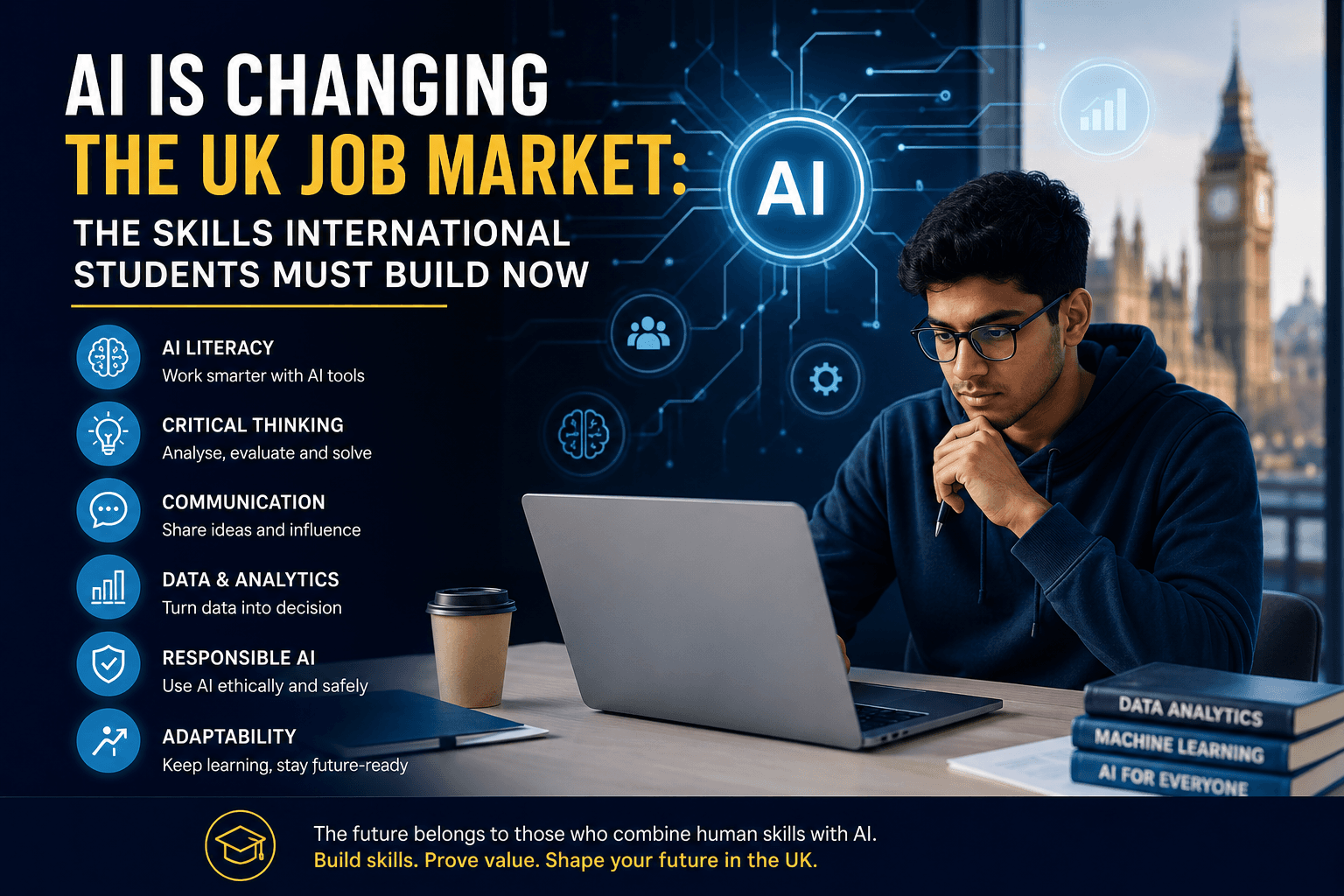
Skill 1: Practical AI literacy
Practical AI literacy means knowing how to use AI tools properly in real work situations.
This does not mean simply copying and pasting from ChatGPT. It means understanding how to use AI to support research, planning, analysis, communication, productivity and decision-making.
For example, a student can use AI to:
summarise complex reports
prepare interview answers
analyse job descriptions
improve CV wording
generate project ideas
build study plans
create first drafts of emails or reports
compare career pathways
automate repetitive tasks
But AI literacy also means knowing the limits. AI can make mistakes. It can produce biased, outdated or inaccurate information. Employers will not value candidates who blindly trust AI. They will value candidates who can use AI carefully, check outputs, improve them and apply human judgement.
That is why practical AI literacy should become a core employability skill for every international student.
Skill 2: Critical thinking
As AI tools become more common, critical thinking becomes more valuable, not less.
AI can produce information quickly, but it cannot always tell whether something is correct, relevant, ethical or suitable for a specific business context.
Critical thinking helps you ask better questions:
Is this information accurate?
Does this answer the real problem?
What evidence supports this?
What is missing?
What are the risks?
How would this affect customers, employees or the business?
The Skills England report specifically highlights communication, critical thinking and analytical skills as cross-cutting skills workers need to access AI effectively.
For international students, this is a big opportunity. You do not need to be the most technical person in the room. But if you can think clearly, question assumptions and make good decisions with AI-supported information, you become much more employable.
Skill 3: Communication
AI can generate words, but it cannot replace strong human communication.
Employers still need people who can explain ideas, influence teams, speak with customers, write clearly, present findings and build trust.
In an AI-powered workplace, communication becomes even more important because someone has to translate information into action.
For example:
A data analyst must explain insights to managers.
A project coordinator must communicate risks and timelines.
A marketing assistant must turn AI-generated ideas into brand-appropriate campaigns.
A compliance officer must explain rules clearly to different teams.
A healthcare worker must communicate with empathy and professionalism.
International students should pay serious attention to communication skills. This includes written English, spoken confidence, presentation skills, professional email writing, interview storytelling and the ability to explain technical ideas in simple language.
AI may help you draft, but your communication style is still your career asset.
Skill 4: Data and analytical skills
AI and data are closely connected.
Even if you are not a data scientist, employers increasingly want people who can understand data, interpret trends and make evidence-based decisions.
This is useful across many fields:
Business students need data for market analysis.
Finance students need data for reporting and risk.
HR students need data for workforce planning.
Marketing students need data for campaign performance.
Healthcare students need data for service improvement.
Project managers need data for tracking progress and outcomes.
You do not need to master everything at once. Start with practical tools such as Excel, Google Sheets, Power BI, Looker Studio, SQL basics, dashboards and simple data storytelling.
The goal is to show employers that you can turn information into insight.
Skill 5: Digital confidence
Digital confidence is different from being “good with computers.”
It means being comfortable learning new tools, testing systems, adapting to new platforms and improving how work gets done.
The UK workplace is becoming more digital. Employers use tools for communication, project management, customer management, recruitment, reporting, finance, compliance and automation.
International students should become familiar with tools such as:
Microsoft Excel and PowerPoint
Google Workspace
Notion or Trello
Slack or Microsoft Teams
CRM tools
AI assistants
dashboard tools
basic automation tools
LinkedIn and digital networking platforms
You do not need to know every tool. But you must show that you can learn quickly and use technology to improve productivity.
Skill 6: Responsible AI use
Employers are not just asking, “Can you use AI?”
They are also asking, “Can you use AI safely and responsibly?”
Responsible AI use means understanding privacy, accuracy, bias, confidentiality and ethics.
For example, you should not paste confidential company information into random AI tools. You should not use AI to create fake experience. You should not submit AI-generated work without checking it. You should not allow AI to replace your own judgement.
The Skills England report highlights responsible AI capabilities as part of what employers increasingly value.
This is especially important for students going into finance, law, healthcare, HR, compliance, public services, data and technology roles.
Responsible AI use can become a serious advantage if you can show employers that you understand both the power and the risks of AI.
Skill 7: Adaptability and lifelong learning
The Skills England report makes another important point: people will need to upskill and reskill throughout their careers as job roles evolve. It also highlights workforce resilience as a key priority in making sure AI adoption supports productivity and opportunity rather than increasing inequality.
This means your first degree will not be your final skillset.
International students must build the habit of continuous learning.
That could mean taking short courses, gaining certificates, joining professional communities, attending webinars, building projects, learning new tools or volunteering in roles that develop practical experience.
The students who win in the job market will not be the ones who only studied once. They will be the ones who keep learning.
What this means for different students
For business students, AI skills can help with market research, operations, customer analysis, automation and business strategy.
For finance students, AI can support fraud detection, forecasting, reporting, risk analysis and compliance monitoring.
For law students, AI can support legal research, document review, policy analysis and compliance work.
For healthcare students, AI can support digital health, patient administration, care planning and service improvement.
For marketing students, AI can support content creation, audience research, campaign planning and performance analysis.
For project management students, AI can support planning, reporting, risk tracking, stakeholder updates and workflow improvement.
For data and tech students, AI can support coding, analytics, automation, product development and technical problem-solving.
The key is to connect AI to your field. Do not just say, “I know AI.” Say, “I know how AI can improve this type of work.”
How international students can start building these skills now
Start by learning one AI tool properly. Do not just use it casually. Learn how to prompt, refine, fact-check and apply outputs professionally.
Then build small projects. For example, create a market research report, a dashboard, a customer service chatbot concept, a policy summary, a content strategy or an automation workflow.
Next, add evidence to your CV and LinkedIn. Employers need proof. Show what you built, what problem you solved and what tools you used.
You should also practise explaining AI in interviews. A strong answer could sound like this:
“I use AI as a productivity and research support tool, but I always verify the output. For example, I used it to structure a market analysis project, then checked the data sources, refined the recommendations and presented the final insight in a clear report.”
That sounds much better than simply saying:
“I use ChatGPT.”
The ISCANET view
At ISCANET, we believe international students and skilled migrants must prepare for the job market that is coming, not the one that existed five years ago.
AI will not remove the need for talent. But it will change what strong talent looks like.
The strongest candidates will be those who combine:
academic knowledge
practical AI literacy
communication
critical thinking
digital confidence
data awareness
responsible judgement
adaptability
proof of real skills
This is why career preparation must go beyond CV templates and job applications. Students need skills, evidence, confidence and a clear understanding of what employers actually need.
Final thoughts
AI is changing the UK job market, but it is not the end of opportunity for international students.
It is a signal to prepare differently.
The students who struggle will be those who ignore the shift, rely only on their degree and continue applying blindly.
The students who stand out will be those who learn AI tools, build practical skills, communicate their value clearly and show employers that they are ready for the future of work.
In the UK job market, the future belongs to candidates who can combine human intelligence with digital capability.
And for international students, the time to start building those skills is now.
Tags:
Comments (0)
Leave a comment
No comments yet. Be the first!