
For many people on a UK Skilled Worker visa, their immigration status is closely connected to their employer.
That dependency can create a serious vulnerability when an employer becomes abusive or exploitative. A worker may fear that speaking out, leaving the job or challenging their employer could also put their immigration status at risk.
A significant change to the UK Immigration Rules is intended to address that problem for some of the most serious cases.
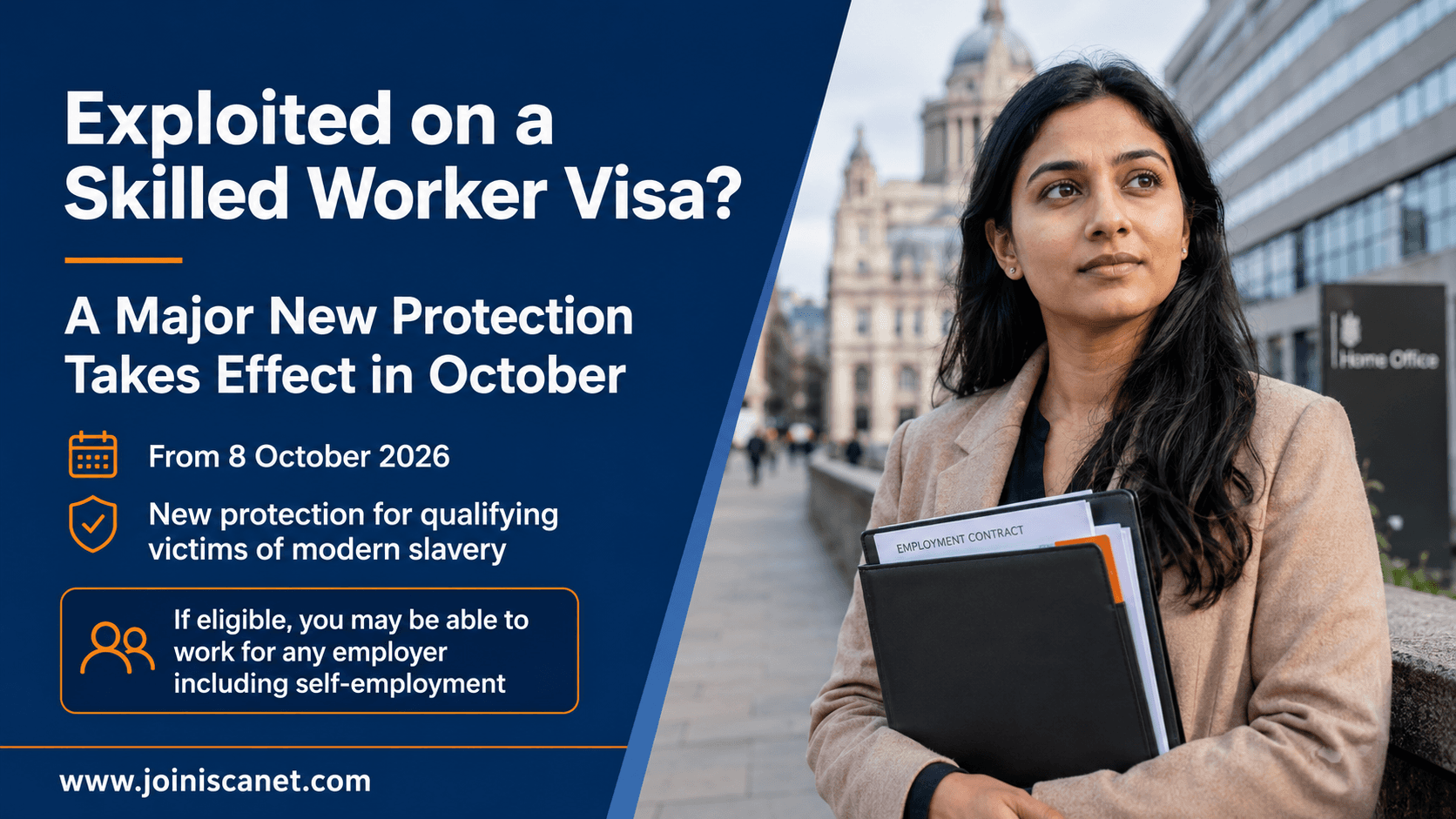
From 8 October 2026, certain Skilled Worker visa holders who have been formally recognised as victims of modern slavery will be able to have their work restrictions changed so that they can work for any employer, including through self-employment - for the remaining duration of their existing permission. (GOV.UK)
This is potentially a major protection for migrant workers. But it is important to understand exactly who qualifies, because the change does not apply to every worker experiencing poor treatment or exploitation.
What is changing on 8 October 2026?
Normally, a Skilled Worker visa is tied to a specific sponsored job.
Under the existing rules, Skilled Workers are generally permitted to work in the job for which they are sponsored, with limited provisions for supplementary employment, voluntary work and working out a contractual notice period. Changing employer will normally require a new eligible job, a new Certificate of Sponsorship and an application to update the Skilled Worker visa. (GOV.UK)
The Home Office's Statement of Changes published on 3 September 2026 introduces a new paragraph, SW 18.3, into Appendix Skilled Worker.
From 8 October 2026, a Skilled Worker who meets the relevant modern-slavery conditions may have the normal employment restrictions in SW 18.2(b) to (e) amended.
Once amended, the worker can undertake:
employment for another employer;
work outside their original sponsored role;
self-employment;
voluntary work; and
other work generally permitted under the new provision.
The main exception is employment as a professional sportsperson, including as a sports coach. (GOV.UK)
The Home Office explains that the purpose is to allow confirmed victims to work for any employer for the remainder of their existing permission and to reduce the ability of exploitative employers to use immigration sponsorship as a means of controlling vulnerable workers. (GOV.UK)
Who will qualify?
This is the most important part of the change.
It is not enough simply to say that your employer is exploiting you.
The new rule applies where the Skilled Worker:
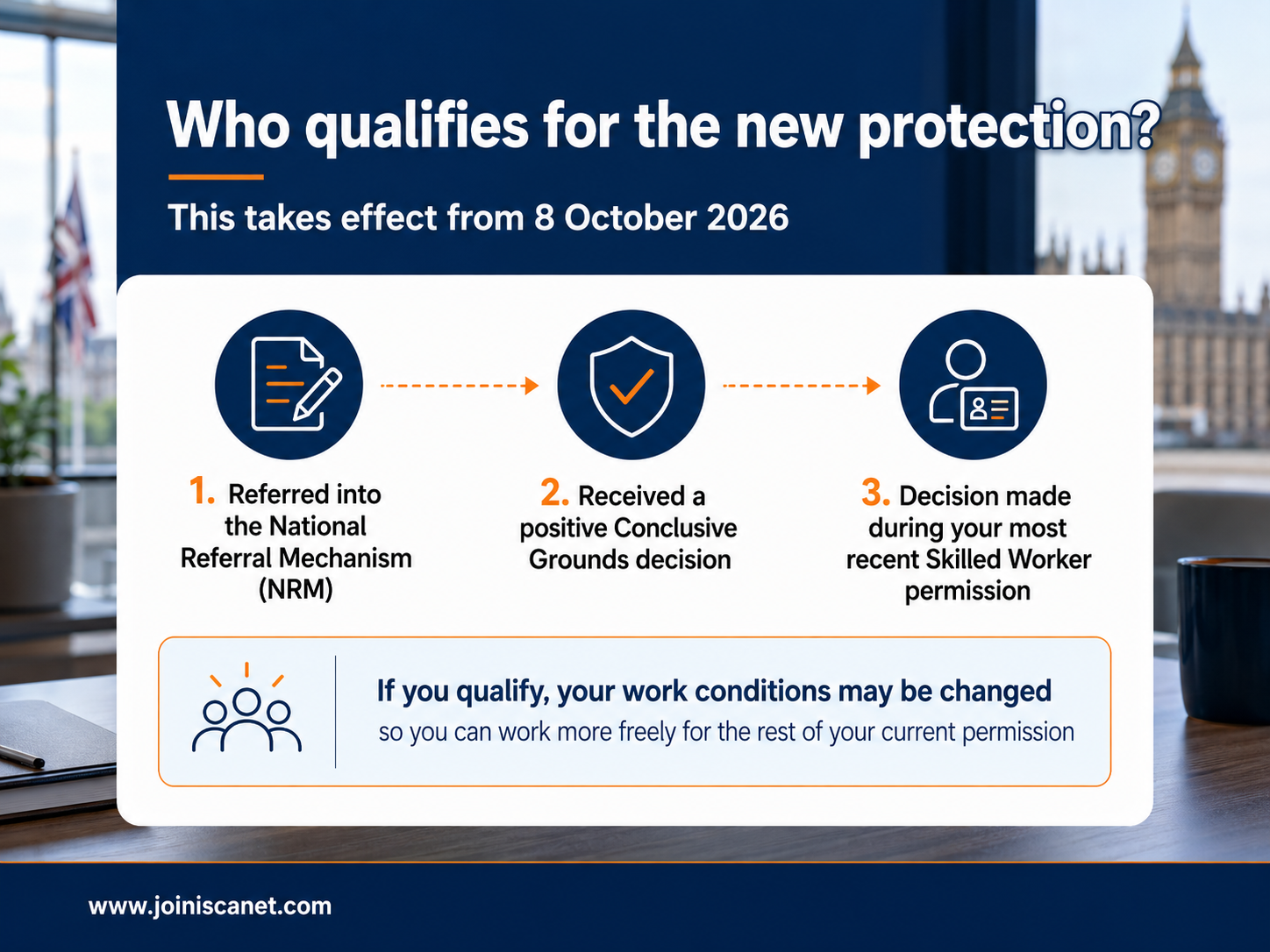
1. Has been referred into the National Referral Mechanism (NRM);
2. Has received a positive Conclusive Grounds decision; and
3. That positive Conclusive Grounds decision was made during their most recent period of Skilled Worker permission. (GOV.UK)
That is a much narrower group than all Skilled Worker visa holders experiencing employment problems.
What is the National Referral Mechanism?
The National Referral Mechanism (NRM) is the UK's framework for identifying and supporting potential victims of modern slavery and human trafficking. (GOV.UK)
Cases generally involve two important stages.
Reasonable Grounds decision
At the first stage, the authorities consider whether there are reasonable grounds to believe that the person may be a victim of modern slavery.
Conclusive Grounds decision
The case is then considered in more detail.
A positive Conclusive Grounds decision means the competent authority has concluded, on the balance of probabilities, that there is sufficient information to consider the individual a victim of modern slavery. (GOV.UK)
It is this positive Conclusive Grounds decision that matters for the new Skilled Worker protection.
A positive Reasonable Grounds decision by itself is not the same thing.
Why does this matter for Skilled Workers?
Imagine a worker whose employer controls their visa sponsorship and tells them:
“If you complain, I will cancel your sponsorship.”
Or a worker whose passport is being withheld, whose wages are being controlled, who has accumulated recruitment-related debt, and who believes they cannot leave because doing so will cause them to lose their immigration status.
Under the normal Skilled Worker framework, moving to another employer can require securing another sponsor and updating the visa.
For someone trapped in a genuinely coercive situation, that dependency can create enormous leverage for an abusive employer.
The Home Office specifically acknowledges this issue.
Its Explanatory Memorandum says the existing sponsorship restrictions may leave victims vulnerable and describes the change as helping to guard against people who attempt to “weaponise the sponsorship system” to exploit workers. (GOV.UK)
The practical significance is clear:
Immigration sponsorship should no longer give an exploiter the same ability to trap a confirmed victim in that employment relationship.
What could workplace exploitation or modern slavery look like?
Modern slavery is much more serious than simply having a difficult manager or being unhappy at work.
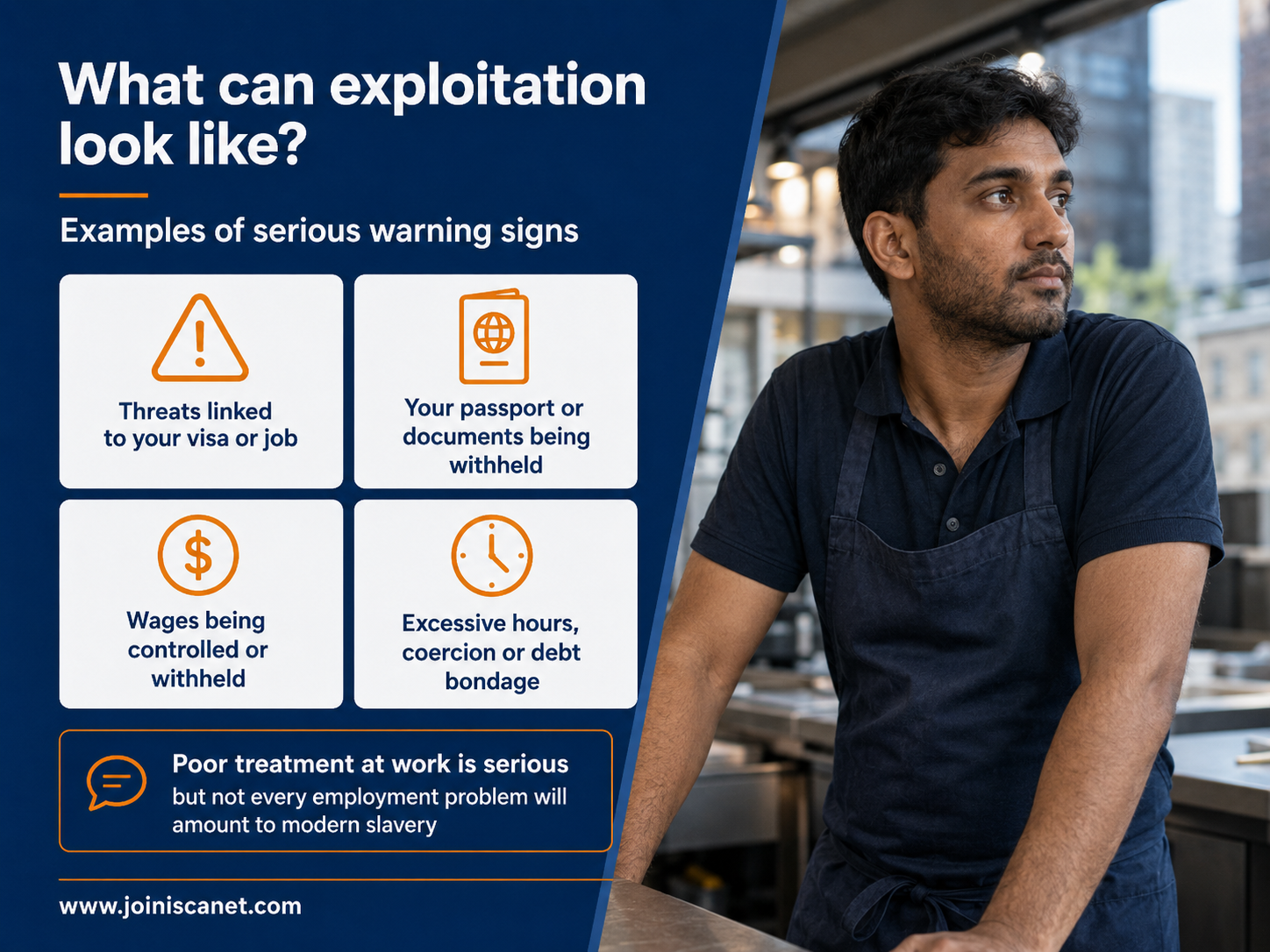
Government guidance identifies possible indicators of forced labour and serious exploitation including:
threats of violence or harm;
threats connected to a worker's immigration status;
an employer taking or withholding a worker's passport or identity documents;
preventing someone from leaving work or accommodation;
controlling a worker's movements;
withholding wages;
debt bondage;
excessive or unexplained deductions;
excessive working hours;
coercion or intimidation;
controlling access to a person's bank account;
forcing workers to live in employer-controlled accommodation; and
deliberately isolating workers from other people. (GOV.UK)
One factor alone does not necessarily establish that someone is a victim of modern slavery. Circumstances need to be assessed individually.
Important: Bad employment practices do not automatically mean modern slavery
This distinction is essential.
An employer could potentially breach employment law by:
underpaying you;
refusing holiday entitlement;
making unlawful deductions;
failing to follow your contract;
treating you unfairly; or
creating poor working conditions.
Those matters can be serious and may justify obtaining employment advice or reporting the employer.
But they do not automatically mean that the worker qualifies as a victim of modern slavery or for the new immigration protection.
Modern slavery can include human trafficking, slavery, servitude and forced or compulsory labour. (GOV.UK)
Workers should therefore avoid assuming that every sponsorship dispute will allow them to work freely for another employer from October.
Does the worker automatically become free to change employer?
The wording of the new rule is important.
Appendix Skilled Worker will say that a qualifying person “may have” their conditions amended so that any work is permitted. (GOV.UK)
So workers should not simply assume that a positive decision means they can immediately start another job without ensuring that the relevant immigration conditions have actually been changed.
Where this applies to you, obtain confirmation of your immigration conditions and, where appropriate, regulated immigration advice before starting work that would otherwise breach your Skilled Worker conditions.
Does the protection give you a new visa?
No.
The Home Office describes the change as allowing the individual to work freely for the remaining duration of their existing permission. (GOV.UK)
It does not, by itself:
extend the expiry date of the Skilled Worker visa;
automatically grant indefinite leave to remain;
automatically create a new immigration route; or
remove every other condition attached to the person's immigration permission.
For example, the new provision specifically changes the work-related conditions in SW 18.2(b) to (e). Other conditions of Skilled Worker permission are not automatically removed. (GOV.UK)
What happens when the person's existing permission approaches expiry will therefore need to be considered separately.
Why this change could be particularly important in sponsored employment
UK employers who sponsor migrant workers hold significant responsibilities.
For most legitimate employers, sponsorship simply enables them to recruit workers internationally.
But sponsorship can become dangerous when an abusive employer deliberately convinces a worker that:
“Your visa belongs to us.”
It doesn't.
A sponsor has immigration compliance responsibilities, but that does not give an employer ownership or control over a worker.
The October change recognises a fundamental problem: when a person's ability to remain employed in the UK is tied closely to the organisation potentially exploiting them, fear of losing sponsorship can make it harder for victims to escape or report what is happening.
The Home Office says the new measure is designed both to encourage victims to come forward earlier and to protect workers where sponsorship is being used as a tool of exploitation. (GOV.UK)
Can you refer yourself to the National Referral Mechanism?
Generally, you cannot self-refer into the NRM.
Referrals are made by designated First Responder Organisations, which include certain public authorities, police forces and specified organisations and charities.
For an adult, consent is normally required before an NRM referral is made. (GOV.UK)
So if you believe you are being subjected to serious exploitation, the appropriate next step may involve speaking to an organisation that can assess your situation and, where appropriate, make a referral.
What should you do if you believe you are being seriously exploited?
Your safety should come first.
If there is an immediate risk of injury or danger, GOV.UK advises calling 999 and asking for the police. (GOV.UK)
Where there is no immediate emergency, consider getting confidential support before confronting an employer, particularly where the employer controls your accommodation, documents or finances.
It can also be useful to safely retain evidence where possible, such as:
employment contracts;
payslips;
bank records;
messages with managers or recruiters;
evidence of recruitment payments;
records of deductions;
work schedules or timesheets;
threats relating to your visa;
evidence that someone has retained your passport or documents; and
correspondence concerning sponsorship.
Do not put yourself at additional risk simply to collect evidence.
A simple example of how the new rule could work
Consider Amina, who holds Skilled Worker permission sponsored by Employer A.
During her employment she is subjected to serious coercion and exploitation. She is referred into the National Referral Mechanism.
The Home Office later issues her with a positive Conclusive Grounds decision, formally recognising her as a victim of modern slavery. The decision is made during her current Skilled Worker permission.
From 8 October 2026, under new SW 18.3, she may be able to have the employment restrictions attached to that Skilled Worker permission amended.
Instead of remaining dependent upon Employer A for work, she could then be permitted to work for another employer, or become self-employed, for the remaining period of her existing permission.
That is a substantial difference from the ordinary Skilled Worker position.
What does this mean for employers?
Responsible sponsors should also pay attention to this change.
Sponsorship should never be used to intimidate employees.
Businesses employing sponsored workers should ensure that:
workers understand their employment rights;
recruitment practices are ethical;
prohibited recruitment or sponsorship costs are not passed to workers;
passports and personal documents are not retained;
deductions are lawful and transparent;
employees can raise grievances without immigration-related threats; and
managers understand that sponsorship is an immigration compliance mechanism, not a method of controlling employees.
The Home Office has increasingly tightened sponsor compliance rules, including restrictions introduced in 2025 preventing sponsors from passing certain sponsorship fees and associated administrative costs to sponsored workers. (GOV.UK)
The key date: 8 October 2026
The new Skilled Worker provision takes effect on:
8 October 2026
The new protection applies to qualifying Skilled Workers who have been referred into the NRM and received the required positive Conclusive Grounds decision during their most recent permission. (GOV.UK)
For those workers, the change could break one of the most powerful forms of leverage available to an exploitative employer:
the fear that leaving the employer automatically means losing the ability to work in the UK.
That makes this a relatively small amendment to the Immigration Rules with potentially significant consequences for the people it protects.
Stay informed with ISCANET
UK immigration and employment rules continue to change, particularly for international students, graduates and sponsored workers.
ISCANET helps international talent understand opportunities in the UK, build their careers and stay informed about changes that could affect their journey.
Visit www.joiniscanet.com for more resources, events and career support.
This article provides general information only and does not constitute immigration, employment or legal advice. Modern slavery and immigration cases can involve complex individual circumstances. Where appropriate, seek advice from a suitably regulated immigration adviser, solicitor or relevant support organisation.
Tags:
Comments (0)
Leave a comment
No comments yet. Be the first!