
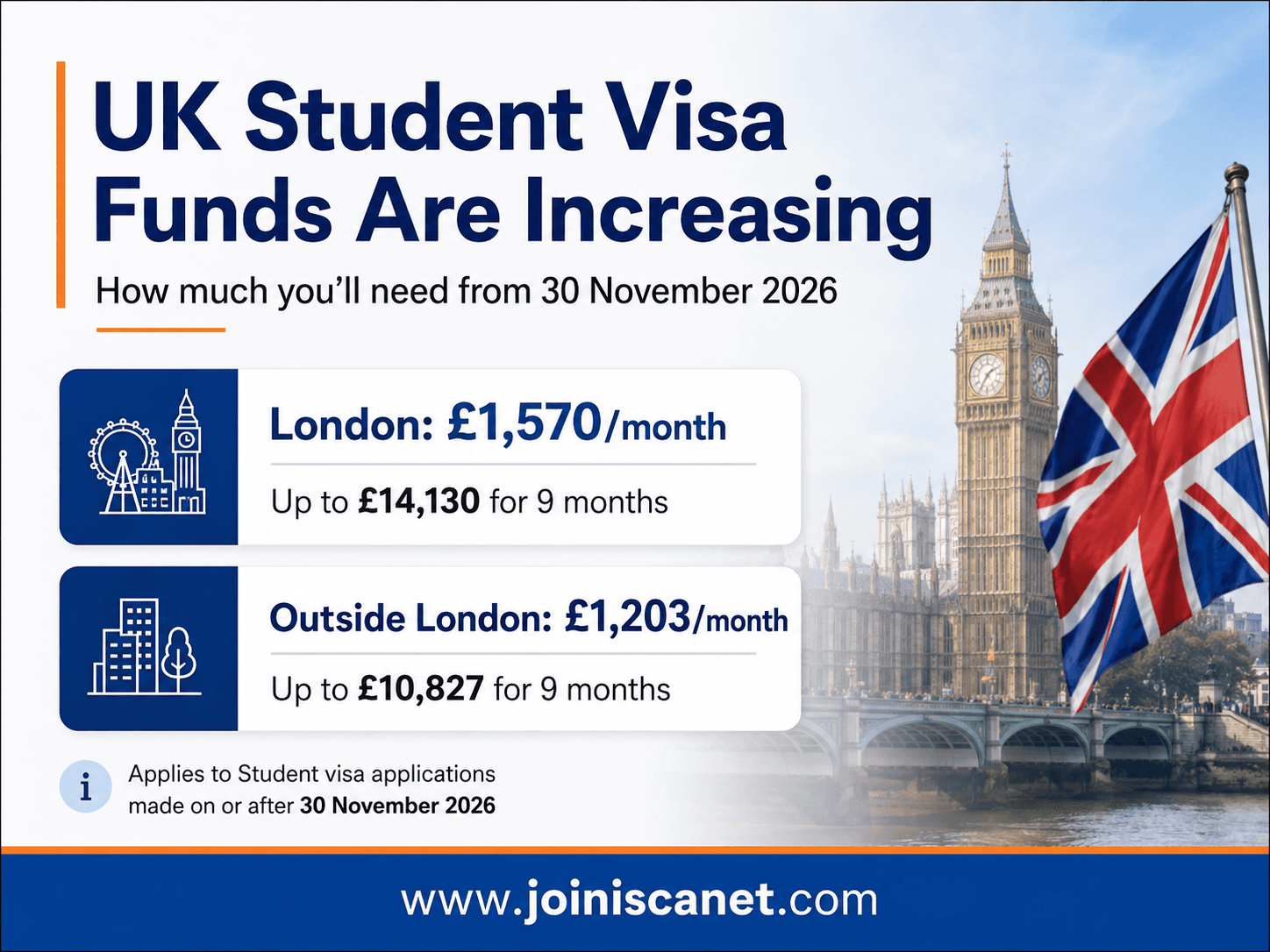
If you're planning to apply for a UK Student visa later this year, there is an important financial change you need to know about. The UK government has confirmed that the amount international students must show for their living costs will increase from 30 November 2026.
Under the new rules, students will need to show:
Where you will study | Current requirement | From 30 November 2026 | Maximum for 9 months |
London | £1,529 per month | £1,570 per month | £14,130 |
Outside London | £1,171 per month | £1,203 per month | £10,827 |
The changes were announced by the Home Office in its Statement of Changes to the Immigration Rules published on 3 September 2026. The government says the increase is designed to keep the Student route maintenance requirement aligned with maintenance support available to home students for the 2026/27 academic year.
When do the new Student visa financial requirements start?
The new figures apply to Student visa applications made on or after 30 November 2026. This distinction is important.
If you submit a qualifying application before 30 November 2026, the Home Office has confirmed that it will be considered under the Immigration Rules in force on 29 November 2026, even if the decision on your application comes later.
So, for example:
Application submitted 29 November 2026: the existing maintenance figures should apply.
Application submitted 30 November 2026: the new maintenance figures apply.
Your university start date is therefore not what determines which maintenance figure applies. The relevant point is when your visa application is made.
How much will you need if you study in London?
From 30 November 2026, the maintenance requirement will be:
£1,570 for each month of your course, up to a maximum of nine months.
For a course lasting nine months or longer:
£1,570 × 9 = £14,130
This is an increase of £369 compared with the current maximum of £13,761.
Remember: this is the living-cost requirement. You may also need to demonstrate that you have enough money to pay any outstanding course fees shown on your Confirmation of Acceptance for Studies (CAS).
Example
Imagine your CAS shows:
Outstanding tuition fees: £8,000
Maintenance requirement: £14,130
You could therefore need to demonstrate access to:
£22,130
subject to any payments, exemptions or other provisions that apply to your individual circumstances.
How much will you need outside London?
Students studying outside London will need:
£1,203 per month for up to nine months.
For a course lasting nine months or longer:
£1,203 × 9 = £10,827
The current maximum is £10,539, meaning the new requirement increases the amount by £288.
For example, if your outstanding course fees are £7,000, you may need:
£7,000 + £10,827 = £17,827
subject to the financial rules applying to your circumstances.
What if your course is shorter than nine months?
You calculate the maintenance requirement according to the number of months of your course, up to the nine-month maximum.
For example, under the new rates:
Course duration | London | Outside London |
3 months | £4,710 | £3,609 |
6 months | £9,420 | £7,218 |
9 months or more | £14,130 | £10,827 |
Where the course includes part of a month, the Student rules provide for that period to be rounded up to the next full month.
You normally need to hold the money for 28 days
Having the required amount in your account on the day you apply is not necessarily enough.
Under the current financial evidence rules, where you are required to demonstrate funds through your own, your parent's or an eligible partner's account, you generally need to have held the required amount for at least 28 consecutive days.
The financial evidence must also normally be dated no more than 31 days before the date of your visa application.
This means students planning to apply shortly after 30 November should prepare early.
You do not want to discover at the point of application that you have enough money today but have not maintained the required balance for the necessary period.
Give yourself a financial buffer
If your funds are held in a currency other than pounds sterling, be particularly careful. The Home Office guidance states that foreign currency is converted into pounds using the OANDA spot exchange rate on the date of application. Exchange rates can move. Rather than keeping exactly £14,130 or £10,827 in equivalent foreign currency, consider maintaining a sensible buffer above the minimum.
Can you use your parents' money?
Yes, subject to the financial evidence requirements. Current Home Office guidance permits students to rely on several sources of funding, including:
their own money;
money held by a parent;
an eligible partner's money;
qualifying student loans; and
official financial sponsorship.
Where you rely on your parent's money, additional evidence, including confirmation that your parent agrees to the funds being used for your studies, may be required. You should always check the latest financial evidence requirements before submitting your application.
What about money already paid to your university?
Payments you have already made can make a significant difference.
Tuition fees
If you have already paid some or all of your course fees to your Student sponsor, this may reduce the outstanding course fee amount you need to demonstrate, provided the payment is properly reflected on your CAS or evidenced in accordance with the rules.
University accommodation
The rules also allow certain accommodation deposits paid to your Student sponsor to be deducted from the required maintenance funds.
From 30 November 2026, the maximum accommodation payment that can be offset under this provision will increase from £1,529 to £1,570.
Importantly, this provision relates to accommodation arranged through the Student sponsor. Do not assume that ordinary payments to a private landlord can automatically be deducted from the maintenance requirement.
What if you have already been living in the UK?
Not every Student visa applicant is required to provide financial evidence in the same way.
For example, current Student visa guidance says that applicants who have been in the UK with valid permission for at least 12 months at the date of their application do not normally need to prove that they meet the Student route financial requirement.
There are also different evidential arrangements for certain nationalities and circumstances.
Always check which rules apply to your particular application rather than assuming that another student's requirements will be identical to yours.
Why is the UK increasing the Student visa maintenance requirement?
According to the Home Office, the Student maintenance requirement is linked to the level of maintenance support available to home students.
The government says the latest increase brings the immigration requirement into line with maintenance loans for the 2026/27 academic year and intends to continue aligning the figures with home-student maintenance support in future.
That also means international students should not assume that today's maintenance figures will remain unchanged indefinitely.
What should prospective international students do now?
If you are planning to study in the UK and expect to apply towards the end of 2026, start your financial preparation early.
1. Check when you expect to submit your visa application.
Applications made from 30 November 2026 will be subject to the increased amounts.
2. Find out whether your university is in London for Student visa purposes.
The London maintenance rate applies to study in the City of London and the 32 London boroughs.
3. Check your CAS carefully.
Find out exactly how much tuition remains outstanding and make sure payments already made are properly recorded.
4. Calculate your maintenance requirement.
Use £1,570 per month in London or £1,203 per month outside London, for up to nine months.
5. Start maintaining the required balance early.
Remember the 28-day financial evidence rule where it applies to you.
6. Keep more than the absolute minimum where possible.
This is especially important when your money is held in another currency.
7. Check the rules again before applying.
Immigration requirements can change, and the documents you need will depend on your individual circumstances.
The bottom line
For Student visa applications made from 30 November 2026, the new maintenance requirements will be:
London
£1,570 per month
Maximum for nine months: £14,130
Outside London
£1,203 per month
Maximum for nine months: £10,827
These amounts are generally in addition to any outstanding course fees you are required to demonstrate.
For many students, the increase itself may not appear huge - £41 more per month in London and £32 more per month outside London - but when combined with tuition fees, exchange-rate movements and the requirement to maintain funds for the required period, early financial planning becomes particularly important.
Planning your journey to study and build a career in the UK?
ISCANET helps international students and professionals navigate opportunities, develop employability skills and prepare for their next steps in the UK.
Explore ISCANET Talent for career resources, events, tools and practical guidance designed to help you move from education into opportunity.
This article provides general information and does not constitute immigration or legal advice. Immigration Rules and guidance can change. Always check the latest GOV.UK guidance or obtain advice from a suitably regulated immigration adviser where necessary.
Tags:
Comments (0)
Leave a comment
No comments yet. Be the first!