
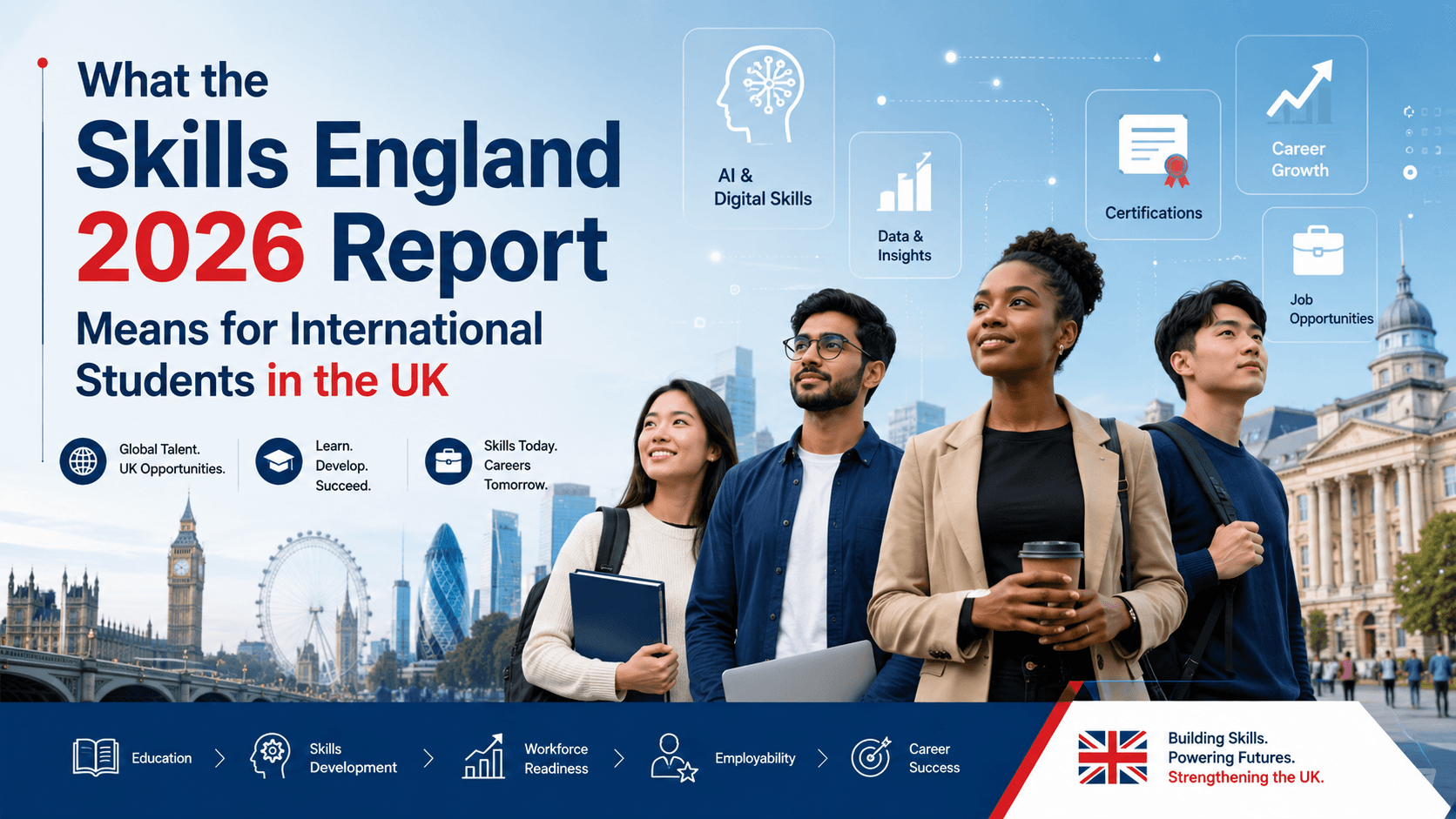
The UK job market is changing fast.
For international students and skilled migrants, this creates both a challenge and an opportunity. The challenge is that having a degree alone may no longer be enough. The opportunity is that the UK is actively looking for people with the right skills, practical experience, adaptability and career readiness.
The Skills England Annual Skills Report 2026 gives a clear picture of where the UK skills system is heading. It highlights five major priorities: tackling skills shortages, increasing employer investment in training, responding to AI, improving young people’s employability, and building a more localised skills system. For international students, this report is not just a government document. It is a signal of where future jobs, training and career opportunities may come from.
1. The UK still has serious skills shortages
One of the biggest messages from the report is that UK employers still struggle to find people with the right skills. The report states that more than a quarter of job vacancies are hard to fill because of skills shortages. It also shows strong expected growth in priority sectors, especially digital, engineering, construction, clean energy and social care.
This matters for international students because many people are applying for jobs without understanding where demand is strongest.
It is no longer enough to say, “I studied business,” “I studied computing,” or “I have a master’s degree.” Employers want to know what problems you can solve and whether your skills match the needs of their sector.
For example, a student with a general business degree may struggle if they apply randomly. But if that same student builds skills in data analysis, AI tools, project coordination, compliance, operations or customer growth, they can become more attractive to employers in growth sectors.
The lesson is simple: international students must stop applying blindly and start aligning their profile with where the UK economy is going.
2. Degrees are still valuable, but skills are becoming more important
The report makes it clear that the UK needs people across different qualification levels. Many high-growth occupations require Level 4 and above qualifications, including higher technical qualifications and degrees. At the same time, sectors such as construction, clean energy and adult social care also need people with Level 2 and Level 3 technical skills.
This is important because many international students assume that the degree is the final destination. In reality, the degree is only the foundation.
The job market is moving towards proof of capability. Employers want to see whether candidates can communicate, solve problems, use technology, work in teams, handle responsibility and adapt quickly.
This is where many international students can lose out. They may have the academic qualification, but not enough visible evidence of workplace skills.
That is why students should start building a stronger career profile early. This can include:
project work
volunteering
internships
short courses
professional certificates
portfolio examples
practical assessments
AI and digital skills
evidence of leadership or teamwork
The future belongs to candidates who can show what they can do, not just what they studied.
3. AI is changing almost every career path
The report identifies AI as one of the biggest forces reshaping the labour market. It says the UK does not only need more AI specialists; the wider workforce also needs to adapt to rapid technological change. Workers will need cross-cutting skills such as communication, critical thinking and analytical skills to use AI effectively.
This is a major opportunity for international students.
You do not need to become a machine learning engineer to benefit from AI. But you do need to understand how AI affects your sector.
A marketing graduate should understand AI content tools, customer data and automation.
A finance graduate should understand AI in fraud detection, risk analysis and reporting.
A law graduate should understand legal technology, compliance tools and AI-assisted research.
A healthcare graduate should understand digital health tools and AI-enabled care systems.
A business graduate should understand automation, CRM tools, dashboards and workflow improvement.
AI will not only create new jobs. It will also change existing jobs. The best candidates will be those who can combine human skills with digital confidence.
For international students, this means AI should not be treated as optional. It should become part of your career preparation.
4. Employability skills are now a major priority
The Skills England report pays strong attention to young people’s employability. It highlights that many young people develop valuable skills through everyday experiences, but those skills are often overlooked because recruiters focus on formal qualifications and paid experience. It also notes that young people often lack a shared language to describe their skills properly.
This point is very relevant to international students.
Many international students have useful experience, but they do not present it well. They may have worked part-time, led student societies, managed family responsibilities, volunteered, supported community projects, helped with events, or built small businesses. But when applying for jobs, they fail to translate those experiences into employer language.
For example:
“Worked in a shop” can become customer service, problem-solving, cash handling, stock management and communication.
“Helped organise an event” can become stakeholder coordination, planning, teamwork, budgeting and delivery.
“Used ChatGPT for assignments” can become research support, productivity improvement, AI-assisted drafting and information analysis — if used responsibly and professionally.
Employability is not just about having experience. It is about being able to explain the value of that experience.
5. Location will matter more in career planning
Another major message from the report is that skills needs are not the same everywhere. Different regions have different economic strengths, job demands and investment priorities. The report supports a more localised skills system, where training and employment support are better connected to local labour market needs.
For international students, this means location strategy is important.
A student looking for a digital role may need to think about where tech employers are growing. Someone interested in clean energy may look at regions investing in green infrastructure. A healthcare or social care candidate may consider areas with strong demand for care workers and NHS-related roles.
Too many international students only focus on London, Manchester or Birmingham. But opportunities can exist across the UK, especially where employers face local skills shortages.
The smarter approach is to ask:
Where is my skill needed?
Which regions have demand for my sector?
Which employers are struggling to recruit?
Which local training or work experience routes can help me get closer to those jobs?
This is the kind of career intelligence that can make job searching more strategic.
6. Skills passports could change how candidates prove their value
One of the most interesting parts of the report is the discussion around skills passports and digital skills wallets. Skills England is exploring how portable records of skills and credentials could help people demonstrate what they can do across sectors and regions. The report notes that skills passports could improve recruitment, help demonstrate credentials and support the portability of skills.
This could be powerful for international students.
One of the biggest barriers international students face is trust. Employers may not always understand overseas qualifications, international experience or non-traditional career paths. A verified skills record could help reduce that gap.
Imagine a student being able to show:
verified assessments
practical projects
employer feedback
completed training
technical badges
employability evidence
sector-specific skills
This is where platforms like ISCANET can play an important role. The future of employability will not only be about uploading a CV. It will be about building a trusted career profile that proves readiness for work.
7. What international students should do now
The report shows that the UK is moving towards a more skills-driven labour market. International students who want to compete must be more intentional.
Here are the key actions to take:
First, identify the sectors where demand is growing. Digital, AI, engineering, clean energy, construction, health, social care, creative industries and technical roles are all important areas to watch.
Second, build practical skills alongside your qualification. Do not wait until graduation before thinking about employability.
Third, learn how to explain your experience in employer language. Every project, job, volunteering role or community activity can become evidence of skills if presented properly.
Fourth, become confident with AI and digital tools. AI literacy will increasingly separate prepared candidates from unprepared candidates.
Fifth, build proof. A CV is not enough. You need a portfolio, project examples, assessments, references, badges and a strong online profile.
Final thoughts
The Skills England 2026 report sends a clear message: the UK needs skilled, adaptable and work-ready people.
For international students, this is encouraging. There are opportunities in the UK economy, but those opportunities will not automatically go to people with degrees alone. They will go to people who understand the direction of the labour market, build relevant skills and prove their value clearly.
At ISCANET, our mission is to help international students and skilled migrants move from uncertainty to opportunity. The future of work in the UK will reward those who prepare early, build the right skills and position themselves strategically.
The question is no longer just, “What did you study?”
The real question is:
What can you do, how can you prove it, and where is your skill needed most?
Ref: Skills England
Tags:
Comments (0)
Leave a comment
No comments yet. Be the first!