Introduction
As a business grows, complexity grows with it.
What once worked with a spreadsheet, a WhatsApp group and a shared folder can quickly become difficult to manage. Customer information may sit inside a CRM, staff details inside an HR system, projects inside another tool, appointments in a separate calendar, and important conversations across email, chat and personal messages.
The result is often more administration, more duplicated work and less visibility. Instead of having one clear picture of the business, owners and managers are forced to piece together information from several different places just to understand what is happening.
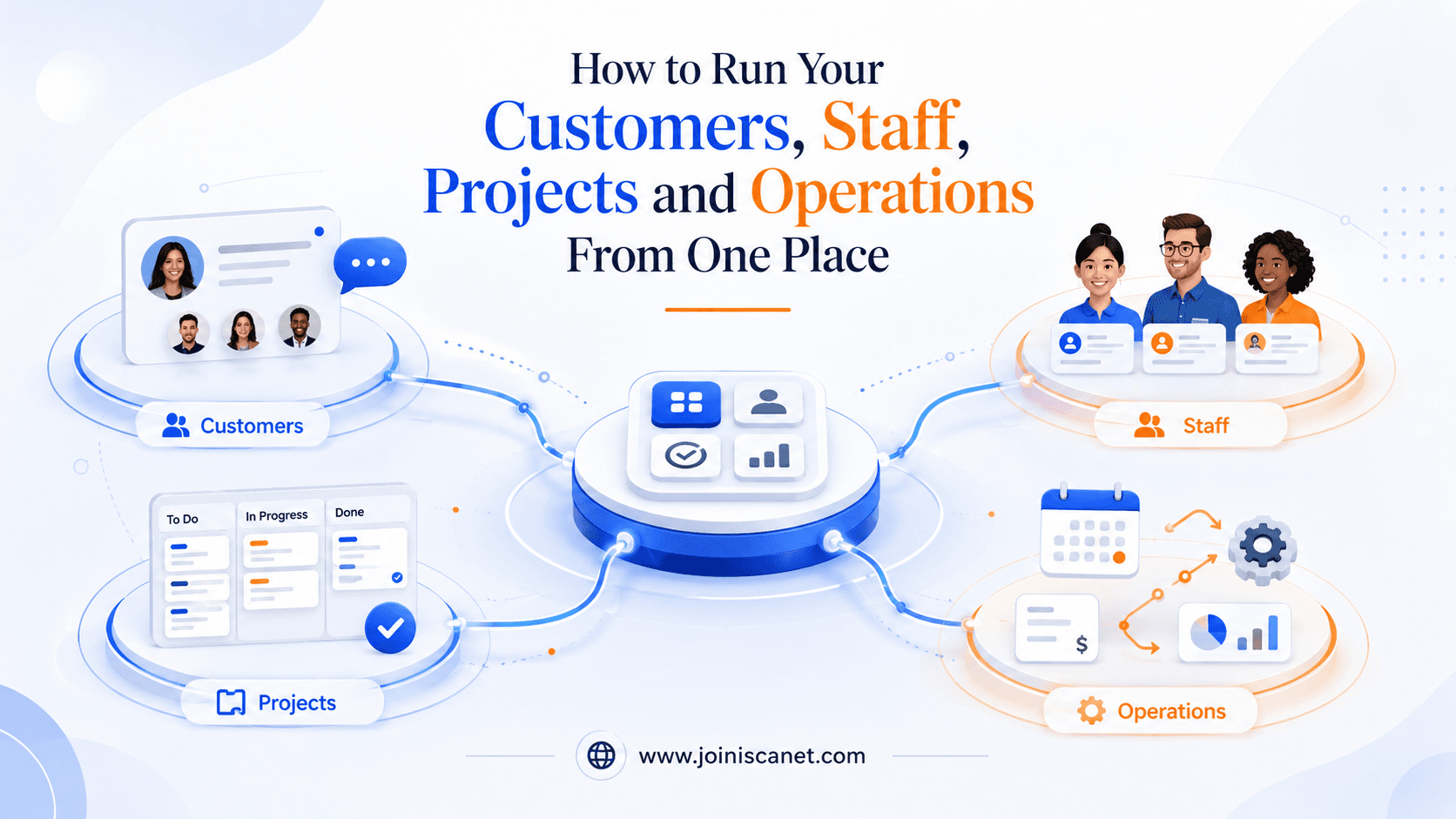
A more effective approach is to bring your core business operations into one connected environment, where customers, employees, projects, tasks, documents, bookings and workflows can work together.
Here is what that can look like in practice.
1. Keep Customer Information in One Central Place
Every customer relationship creates information. There are enquiries, notes, emails, calls, follow-ups, appointments, proposals, tasks and sometimes invoices or projects connected to that customer.
When this information is scattered across different systems, it becomes difficult for teams to understand the full history of the relationship. A central customer record gives your team one place to see the information that matters.
That may include:
Contact details
Previous conversations
Sales opportunities
Follow-up tasks
Notes
Appointments
Documents
Deals
Recent activity
Instead of asking, “Who spoke to this customer last?” or “Did anyone follow up?”, the answer should already be visible.
This creates a more consistent customer experience and reduces the risk of important opportunities being missed.
2. Bring Staff Management Into the Same Operational Environment
Customers are only one side of the business. You also need to manage the people doing the work. As a team grows, employee information becomes harder to manage through informal processes. Leave requests, documents, onboarding, performance conversations, contracts and attendance can quickly become difficult to track.
A structured workforce system helps keep this information organised.
For example, a business may need to manage:
Employee records
Roles and permissions
Leave and absence
Attendance
Documents
Onboarding
Performance information
Recognition and feedback
Employment changes
When workforce information sits alongside wider business operations, managers gain a much clearer understanding of who is available, who is responsible for what and how work is progressing. It also reduces the amount of administration that depends on spreadsheets, email chains and individual memory.
3. Connect Projects, Tasks and Responsibilities
Projects often become difficult to manage when work is split between messages, spreadsheets and personal task lists. One person may be tracking deadlines in a spreadsheet. Another is using their calendar. Someone else is keeping notes in a chat.
That creates a simple problem: nobody has the same view. A connected project and task system gives the business one place to manage what needs to be done.
Each project can have:
Tasks
Owners
Deadlines
Priorities
Notes
Files
Status updates
Related customers
Team members
This makes it easier to see what is on track, what is delayed and where support may be needed.
It also makes accountability much clearer because every task has an owner and every project has a visible status.
4. Stop Re-Entering the Same Information
One of the biggest signs of disconnected operations is repeated data entry. A customer submits a form. Someone manually adds them to a spreadsheet. Then the same information is entered into a CRM. Later, it is copied into a booking system. Then someone re-enters it again when creating an invoice.
Each individual step may only take a few minutes, but over time, the cost becomes significant. A connected business system should allow information to move naturally from one stage to another.
For example:
Enquiry → Customer Record → Follow-Up Task → Deal → Booking → Project → Invoice
The more of this journey that can happen without re-entering the same information, the more time your team can save.
It also reduces errors and makes the business easier to scale.
5. Create Clear Workflows for Repetitive Processes
Many businesses repeat the same processes every week without realising how much time they spend doing so. A new customer enquiry may always require the same response. A new employee may always need the same onboarding steps. A new deal may always require a follow-up task.
A new booking may always require a confirmation and reminder. These are ideal opportunities for structured workflows. Instead of relying on someone to remember every step, businesses can define what should happen when a particular event occurs.
For example:
When a new lead is created:
Assign the lead to a salesperson
Create a follow-up task
Send a confirmation email
Add the opportunity to the sales pipeline
Notify the relevant team member
When a new employee joins:
Create their employee record
Assign their role
Request required documents
Create onboarding tasks
Notify their manager
The goal is not to automate everything.
The goal is to automate predictable work so people can focus on the tasks that require judgement, communication and decision-making.
6. Give Managers Better Visibility
One of the biggest problems in a growing business is not necessarily a lack of activity. It is a lack of visibility. A manager may know that the team is busy but still struggle to answer simple questions such as:
Which deals are close to closing?
Which customers need attention?
Which projects are delayed?
Which tasks are overdue?
Who is responsible for what?
Which employees are away?
Which invoices are outstanding?
Where are the bottlenecks?
When information is spread across several systems, answering these questions can take too long. A connected operating environment gives managers a more complete picture. Instead of relying on meetings and manual updates just to understand what is happening, they can see the relevant information directly.
That allows faster decisions and reduces unnecessary chasing.
7. Keep Business Knowledge With the Business
Every growing company develops knowledge.
There are processes, policies, customer preferences, internal instructions, templates, project history and lessons learned. The problem is that much of this knowledge often stays inside people's heads, personal folders or old message threads. That creates risk. If an employee leaves, changes role or goes on extended leave, important information can disappear with them.
A structured knowledge system helps businesses document and retain what they know. That can include:
Standard operating procedures
Policies
Internal guides
Templates
Customer notes
Project documentation
Training resources
Process instructions
When this information is connected to the rest of the business, teams spend less time searching for answers and are less dependent on individual employees.
8. Connect Appointments, Meetings and Customer Activity
Scheduling is another area that is often disconnected from wider business operations. A customer books an appointment. The booking sits in one system. The customer record is somewhere else. The meeting notes go into a document. Any resulting tasks are then created manually. A connected system reduces that fragmentation. A booking can become part of the customer history. The meeting can create follow-up tasks.
Those tasks can be assigned to the right person. The customer record can show what happened next. This creates continuity. Instead of treating every interaction as a separate event, the business can see the entire customer journey.
9. Build Better Processes Around Money and Cash Flow
Operational visibility should also extend into financial activity.
For many small businesses, invoicing and credit control remain disconnected from the rest of the customer relationship.
A customer may have an active project, an outstanding invoice and an upcoming meeting, but those pieces of information may exist in completely different places.
Bringing them closer together gives the business better context.
For example, a manager can see that a customer has:
An active deal
An ongoing project
An overdue invoice
A scheduled meeting
A recent support request
That context can change how the business handles the relationship.
It also makes it easier to identify overdue payments and take action before cash flow becomes a bigger problem.
10. Create One Source of Truth for the Business
The real value of bringing operations together is not simply convenience.
It is clarity.
A business needs one reliable place where people can understand what is happening.
That does not mean every single activity must happen inside one application.
Businesses will always use specialist tools where appropriate.
But the most important operational information should not be scattered across so many systems that nobody has a complete picture.
A strong operational setup should give you clear answers to questions such as:
Who are our customers?
What are we working on?
What needs attention today?
Who owns each task?
Which employees are available?
Which deals are progressing?
Which invoices are overdue?
Which processes can be automated?
Where is important business knowledge stored?
If these answers are easy to find, the business becomes easier to manage.
What Does a Connected Business Actually Look Like?
A connected business does not mean having more software. It means reducing unnecessary fragmentation. A typical customer journey might look like this:
A prospect submits an enquiry form.
Their details automatically create a customer record.
A sales opportunity is added to the pipeline.
A follow-up task is assigned.
The prospect books a meeting.
The meeting outcome is logged.
Once they become a customer, a project is created.
Tasks are assigned to the team.
Relevant documents are stored alongside the work.
An invoice is issued.
Follow-up activity continues from the same customer history.
Instead of information constantly being moved between disconnected systems, the business operates as one continuous process.
That is the real advantage.
How ISCANET Helps Businesses Work From One Place
ISCANET is designed to help growing businesses bring customers, workforce and day-to-day operations together in one connected platform.
Businesses can manage areas such as:
CRM and sales
Projects and tasks
Workforce and HR
Recruitment
Appointments and scheduling
Forms
Documents and knowledge
Meetings
Invoices and credit control
Workflows and automation
The aim is not simply to give businesses another piece of software.
It is to reduce the number of disconnected processes owners and teams have to manage.
When your customer information, staff, projects, tasks and workflows can work together, the business becomes easier to understand and easier to operate.
One Business, One Clearer Operating System
Growth naturally creates complexity.
More customers mean more conversations.
More employees mean more coordination.
More projects mean more deadlines.
More activity means more information.
The answer is not necessarily to keep adding separate tools every time a new problem appears.
At some point, the business needs a more connected way of working.
Bringing your customers, staff, projects and operations into one place can reduce duplication, improve visibility and make it easier for your team to focus on the work that actually moves the business forward.
If your current setup feels increasingly difficult to manage, that may be a sign that your business has reached the point where its systems need to grow with it.
Ready to bring more of your business into one connected workspace?
Explore ISCANET Business and discover a simpler way to manage your customers, team and operations.
Visit www.joiniscanet.com/business.
Tags: